Quick answer: Choose an e-bike conversion kit battery by matching the system voltage, full-charge voltage, controller battery-current limit, pack discharge capability and approved charger. Then size energy in watt-hours for the route and check mounting, wiring and destination-market requirements. Capacity in Ah alone does not establish compatibility.
This guide is for conversion-kit buyers, workshops and distributors. It explains how to compare a battery with the rest of the system before placing an order. Electrical examples are illustrative calculations, not specifications or safety approvals for a particular ECOWAY TECH product.
1. Understand the four battery ratings
| Rating | What it tells you | What to verify |
|---|
| Nominal voltage (V) | The pack’s voltage class, not its fully charged voltage. | Supported battery chemistry, series count and the controller’s full operating-voltage range. |
| Capacity (Ah) | Rated electrical charge capacity. | Test conditions, usable capacity and the pack’s separate current limits. |
| Energy (Wh) | A useful measure for comparing packs with different nominal voltages. | Nominal V × rated Ah; actual usable energy varies with conditions. |
| Discharge current (A) | The pack’s permitted continuous and short-duration current. | Complete-pack ratings, BMS limits, peak duration, wiring and connectors. |
How to calculate watt-hours
Nominal energy (Wh) = nominal voltage (V) × capacity (Ah). A 48V 14Ah pack has 672Wh of nominal energy. A 36V 14Ah pack has 504Wh. Equal Ah ratings do not mean equal energy when voltage differs.
2. Match battery voltage to the complete system
Use the battery’s datasheet, not only the voltage printed in a product title. The controller, display, lights, wiring and any DC converter must support the complete operating range. Low-voltage cut-off and charging requirements also depend on the chemistry and series count.
| Common label | Example cell arrangement | Example full-charge voltage |
|---|
| 36V lithium-ion | 10 cells in series (10S), 4.2V maximum per cell | 42.0V |
| 48V lithium-ion | 13S, 4.2V maximum per cell | 54.6V |
| 52V lithium-ion | 14S, 4.2V maximum per cell | 58.8V |
These examples apply to packs designed for a 4.2V-per-cell charging limit. LiFePO4 and other chemistries require their own approved charging profile. Do not select a charger from this table without checking the exact pack specification.
Can a 52V battery replace a 48V battery? Only if the system supplier explicitly approves that combination. A controller capacitor’s voltage marking alone is not enough: semiconductor ratings, firmware, cut-off settings and connected accessories also matter. Do not use a higher-voltage pack as an unverified upgrade.
3. Check discharge current, not just motor wattage
Identify the controller’s battery-current limit. Motor phase current is a different quantity and must not be substituted for it. Request the pack’s rated continuous output and any peak-current rating with its allowed duration and temperature conditions.
For example, a controller limited to 20A of battery current needs a battery approved to supply that demand under the intended conditions. A pack rated below the required current is unsuitable. Any additional design margin should be agreed with the battery and controller suppliers rather than treated as a universal percentage rule.
Use C-rate as a calculation, not proof of pack quality
Current (A) = capacity (Ah) × C-rate. A 10Ah pack rated at 1C corresponds to 10A, while 3C corresponds to 30A. This does not prove that the complete pack can safely provide that current: cell data, parallel-cell count, BMS, interconnects, temperature and ageing must all be considered. A cell or BMS headline rating alone does not validate the assembly.
4. Estimate energy for the route
Calculate the required energy from measured consumption for a similar bike, load and route where possible. Rider input, speed, hills, wind, tyres, temperature and battery condition can change the result substantially.
Required usable energy (Wh) = route distance (km) × consumption (Wh/km). As an arithmetic example, 40km at an assumed 7Wh/km requires 280Wh of usable energy. If only 80% of nominal pack energy is allocated to that trip, nominal capacity would need to be at least 350Wh. At 48V, that is approximately 7.3Ah before any further allowance for the operating conditions.
The 7Wh/km and 80% values are assumptions for this calculation, not tested range claims or mandatory battery settings. Confirm the reserve and temperature allowance for the actual application; Ah does not guarantee a distance.
5. Check mounting space and battery removal
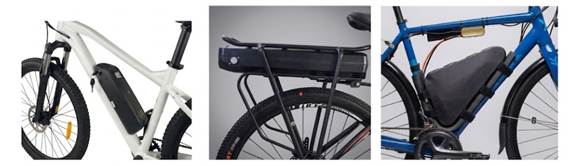 Illustrative mounting formats. Check the actual battery and bracket drawing before ordering.
| Format | When to consider it | Checks before ordering |
|---|
| Downtube or slider case | A frame with suitable mounting points and clearance. | Case dimensions, removal direction, bracket strength, fasteners and cable routing. |
| Rear-rack case | Step-through or compact frames where an approved rack can carry the assembly. | Rack/frame load limits, mounting security, weight distribution and removal clearance. |
| Triangle enclosure or bag | A compatible frame with an approved support arrangement. | Suspension movement, strap/support design, abrasion, water exposure and access. |
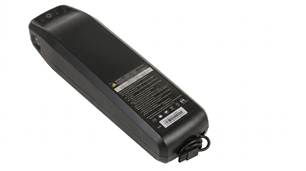 Example case only; the image does not establish voltage, capacity, current or included components.
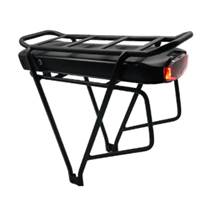 Confirm the rack and frame load limits for the actual build.
Do not assume a universal clearance such as 2–5cm. Use the model-specific installation drawing and allow space to release the lock, disconnect safely and remove the pack without forcing it.
6. Verify cells, connectors and supplier documents
Ask for traceable cell and pack models, pack assembly details, current ratings and after-sales identification. A recognised cell brand is not a substitute for verified pack design, manufacturing quality or certification. Do not make a purchase decision from a claimed cell brand alone.
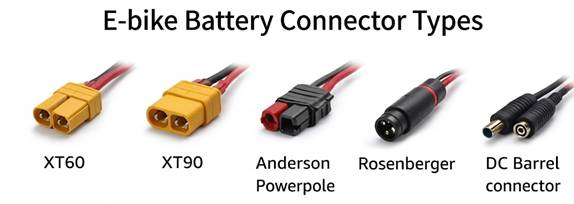 Connector-family illustrations only. Appearance does not establish polarity, current rating or interchangeability.
Confirm connector manufacturer and part number, polarity, pinout, wire size, operating current and mating compatibility. Do not choose a connector solely from motor wattage, colour or an apparently matching shell. Never modify live wiring or assume an anti-spark connector makes an incompatible system safe.
7. Separate battery, system and transport requirements
Standards serve different purposes. UL Solutions distinguishes battery evaluation from the complete e-bike electrical system. Transport testing is another separate requirement. Whether a specific standard is legally required depends on the jurisdiction, product and sales channel; there is no single worldwide approval.
| Document or standard | Scope to understand | Buyer check |
|---|
| UL 2271 | Batteries for light electric vehicle applications. | Verify the exact pack model and certification scope with the issuing body. |
| UL 2849 | E-bike electrical system evaluation. | A certified cell or battery alone does not establish certification of the complete system. |
| EN 15194 / relevant European requirements | Electrically power-assisted cycle requirements; other product and battery rules may also apply. | Ask which standards and legislation apply to the actual product and market; a CE mark is not a generic third-party battery certificate. |
| UN 38.3 transport tests and test summary | Transport-related battery design testing and traceability. | Request the matching test summary and shipment-specific documentation; an SDS does not replace UN 38.3 testing. |
Check model identifiers, certificate holder, issuing body and online verification where available. Do not treat a cell certificate, an unrelated pack certificate or a supplier’s PDF image as proof for another assembly. Consult the importer, laboratory or qualified compliance adviser for the destination market.
8. Charge, store and inspect the battery safely
Use the charger supplied or expressly approved for the exact battery; match chemistry, output voltage, current, connector and any communication requirements.
Follow the battery manufacturer’s permitted charging and storage temperatures. A pack brought in from the cold may need time to warm and dry before charging.
Use an appropriate charging location away from escape routes and combustible material; follow the manufacturer’s instructions and do not leave a damaged pack charging.
Stop use if the pack shows unusual heat, swelling, leakage, odour, damage or other warning signs. Seek professional advice rather than opening or repairing the pack.
These points are consistent with the UK government’s battery-safety guidance linked below. Product-specific instructions take precedence over a generic storage percentage or temperature rule.
Battery selection FAQ
Does a larger Ah battery make a motor more powerful?
Not by itself. Ah describes charge capacity. Available performance also depends on voltage, pack current capability, controller settings and the motor. A larger-capacity pack still has to be compatible with the whole system.
Is a higher BMS current rating always better?
No. The pack must meet the application’s approved current demand, but a higher BMS label does not prove that the cells, wiring or assembly can safely support it.
What information should I send for a battery quotation?
Send the kit and controller model, nominal and full-charge voltage, battery-current limit, target energy, mounting dimensions, connector/pinout, destination market and expected quantity. Confirm the final battery, charger and component list before ordering.
Discuss a conversion-kit configuration
Explore hub motor kits or mid-drive kits, and review the controller compatibility guide. Contact ECOWAY TECH with the system details above for a configuration review.
For related components, read the charger selection guide and the cadence versus torque sensor guide.
Sources and further reading

